
Introduction – When Reel Becomes Real
Cinema and storytelling have always been powerful media to shape our imagination, emotions, and culture. For decades, films have entertained us with drama, comedy, romance, and action. However, in the past two decades, there has been an undeniable surge in action-heavy, brutal, and violent content, not only in films but also on OTT platforms, web series, and even video games. What makes this concerning is not just the rising popularity of such content but also its impact on young, impressionable minds.
Adults often watch violent films and walk away unaffected, separating fiction from reality. Teenagers and children, however, live in a world where lines between reel and real are blurred. Their curiosity, coupled with a lack of emotional maturity, makes them vulnerable to absorbing violence as an acceptable way of expressing anger or gaining power. The tragic incident in Ahmedabad, Gujarat, in August 2025, where a Class 10 student was fatally stabbed by his Class 8 junior outside their school, serves as a painful reminder that what we feed into young minds—through media, peer culture, and society—can sometimes manifest in the ugliest ways.
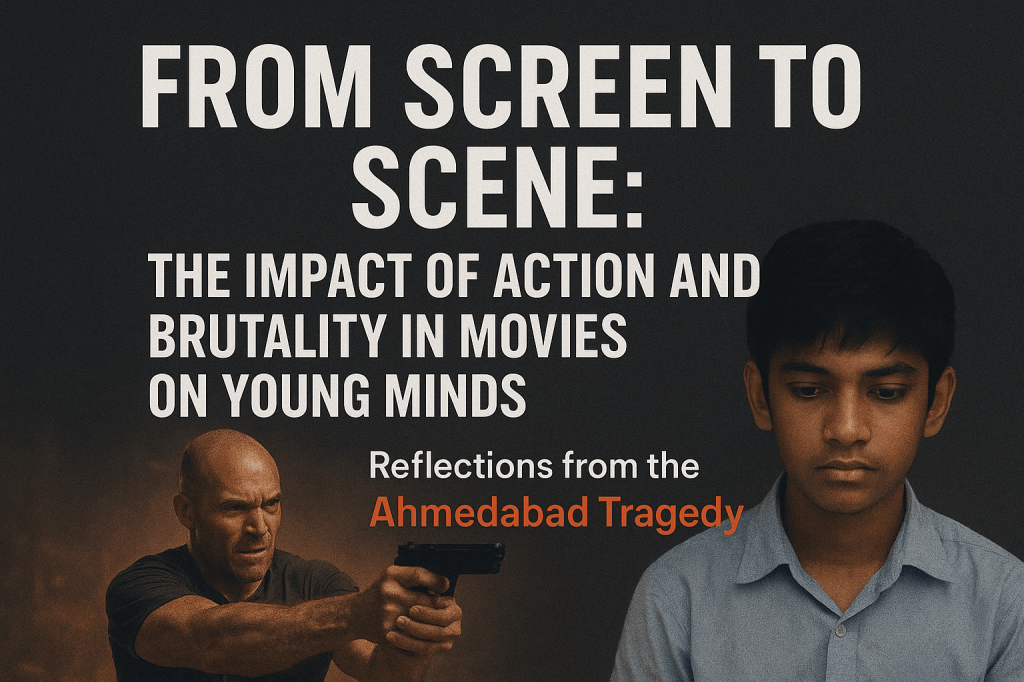
The Ahmedabad Case – A Harsh Wake-Up Call
The Ahmedabad school tragedy shook not just the local community but the entire country. A minor dispute between two boys escalated into an unthinkable crime. A 14-year-old Class 8 student stabbed his 16-year-old senior, leading to the latter’s death just outside the school campus. What made the case even more disturbing was the alleged mishandling by the school authorities. Instead of calling an ambulance immediately, reports suggest that a water tanker was summoned to wash away bloodstains, as if cleaning the ground was more important than saving a life. This sparked widespread anger, protests by parents, and raised questions about the priorities of educational institutions.
Further investigation revealed WhatsApp chats of the accused boy, where he spoke about stabbing in an almost casual manner, describing it as something not very serious. This flippant attitude toward such a grave act was alarming and hinted at something deeper—the desensitization of violence among youth. When murder is treated as a joke in casual conversation, it shows how normalized brutality has become in certain peer circles.
The incident is not just about one boy’s mistake. It reflects institutional negligence, lack of conflict-resolution systems in schools, absence of mental health support, and most importantly, a larger cultural acceptance of aggression, often glorified by entertainment media.
Why Movies and Media Influence Young Minds So Strongly
Children and teenagers are not just passive consumers of media; they are active absorbers. Their brains are still developing, particularly the prefrontal cortex, which governs decision-making and impulse control. This makes them more prone to imitating behaviors they see repeatedly. When violent heroes dominate screens, when power is shown to be achieved through aggression, and when brutal acts are portrayed without consequences, youngsters begin to internalize that narrative.
Films and OTT content today are saturated with imagery of revenge, bloodshed, and ruthless survival. Heroes are often celebrated not for patience or dialogue but for their ability to overpower enemies through violence. While such content may serve as adrenaline-filled entertainment for adults, it sends confusing signals to adolescents, who may see violence as both glamorous and effective. Psychologists describe this as the Social Learning Effect—the process by which people model behaviors they observe, especially if those behaviors appear to bring rewards such as respect, fear, or dominance.
Over time, this leads to desensitization. A teenager who watches multiple brutal fight sequences or gun battles may no longer feel shocked by blood, injuries, or even murder. Instead, they may laugh it off, discuss it casually, or worse, experiment with it. This phenomenon was disturbingly evident in the Ahmedabad case, where the accused’s casual attitude toward stabbing showed a lack of emotional depth about the seriousness of his act.
The Psychology of Violence Consumption
Several psychological concepts help explain how constant exposure to violent content impacts young people.
- Desensitization – When violence is repeatedly shown on screen, the shock value diminishes. Youngsters stop reacting emotionally to brutality, treating it as normal.
- Normalization – If heroes in films solve problems with fists, knives, or guns, violence begins to appear as a legitimate solution to conflicts. Over time, aggression becomes a socially acceptable behavior in peer groups.
- Moral Disengagement – Violent media often distances viewers from the moral implications of actions. For example, a hero killing dozens of people is justified because he is “fighting for justice.” Adolescents may copy this rationalization, thinking their aggression is also justified in certain contexts.
- Identity Formation – Teenagers are in the process of defining who they are. If their favorite hero is an action star who commands respect through violence, they may subconsciously adopt similar traits to appear “cool” or powerful among peers.
- Impulse Control Issues – Since adolescents already struggle with emotional regulation, exposure to cinematic aggression can act as a trigger. A small fight in real life can quickly spiral into dangerous aggression, as seen in the Ahmedabad incident.
The Broader Social Ecosystem
While it is easy to blame movies alone, the reality is more complex. Violence in media interacts with social, family, and educational factors. A teenager exposed to brutality in films but guided by strong family values and effective school support systems may still navigate it safely. However, when combined with bullying, lack of counseling, peer pressure, and institutional apathy, media violence becomes a dangerous ingredient.
In Ahmedabad, allegations of bullying surfaced soon after the tragedy. The younger boy reportedly faced issues with his senior, and instead of conflict resolution, it escalated into aggression. If the school had systems to address disputes, if there were regular counseling sessions, or if students were educated about handling anger constructively, perhaps the outcome could have been different.
The Responsibility of Media Creators
Filmmakers and content creators have a profound responsibility. Entertainment should not come at the cost of social damage. While it is unrealistic to expect cinema to completely avoid violence, what matters is how violence is framed. If brutality is shown as glamorous and consequence-free, it encourages mimicry. But if it is shown with realistic consequences—trauma, guilt, punishment—it becomes a cautionary tale rather than an inspiration.
Moreover, content rating systems must be strictly enforced. OTT platforms often allow minors to access shows far beyond their age appropriateness. Parents, too, must be conscious of what their children are watching. A violent web series that might be harmless fun for a 30-year-old can be deeply damaging for a 13-year-old struggling to define his worldview.
What Schools and Parents Can Do
The Ahmedabad tragedy has forced us to rethink our approach. Beyond blaming media, it is crucial to strengthen the ecosystem around children.
- Conflict Resolution Training: Schools must introduce programs that teach children how to resolve disputes without aggression. Role-play exercises, group discussions, and peer mediation can help.
- Counseling and Mental Health Support: Regular sessions with psychologists should be part of every school’s infrastructure. Early signs of aggression, isolation, or troubled behavior must not be ignored.
- Parental Guidance: Parents need to be more aware of their children’s media consumption. Open conversations about what they watch, how they feel about it, and why real life is different from reel life can bridge the gap.
- Emergency Response Preparedness: Schools should prioritize saving lives over saving reputation. Clear protocols for emergencies—ambulance first, investigation later—must be non-negotiable.
- Media Literacy Education: Teaching students to critically evaluate films, shows, and online content can empower them to see through the glorification of violence. They should be taught to ask: Is this behavior acceptable in real life? What are its consequences?
Moving Forward – Building a Culture of Empathy
At the heart of this discussion is a need to reintroduce empathy into the lives of young people. Violence thrives when compassion is absent. Films and shows that celebrate kindness, problem-solving, resilience, and dialogue should receive as much attention as those filled with brutality. Society must collectively shift from glorifying power through fear to valuing power through respect and collaboration.
The Ahmedabad case should not be remembered merely as a statistic in juvenile crime. It must be remembered as a turning point—a call to parents, educators, media creators, and policymakers to take responsibility for shaping young minds. We cannot afford to treat these incidents as isolated. They are warnings of a deeper cultural crisis, one that requires collective action.
Conclusion
Violence in movies alone may not directly cause violent behavior, but it is undoubtedly a contributing factor in a larger web of influences. When children consume content that glorifies brutality without consequence, when schools fail to provide safe conflict-resolution mechanisms, and when parents ignore the warning signs, tragedies like Ahmedabad become inevitable.
The time has come to rethink what kind of stories we tell, what values we reinforce, and what lessons we leave for our children. Do we want a generation desensitized to cruelty, or do we want empathetic individuals who choose dialogue over destruction? The answer will define not just our children’s future but the very fabric of our society.
 Shreyas Trivedi